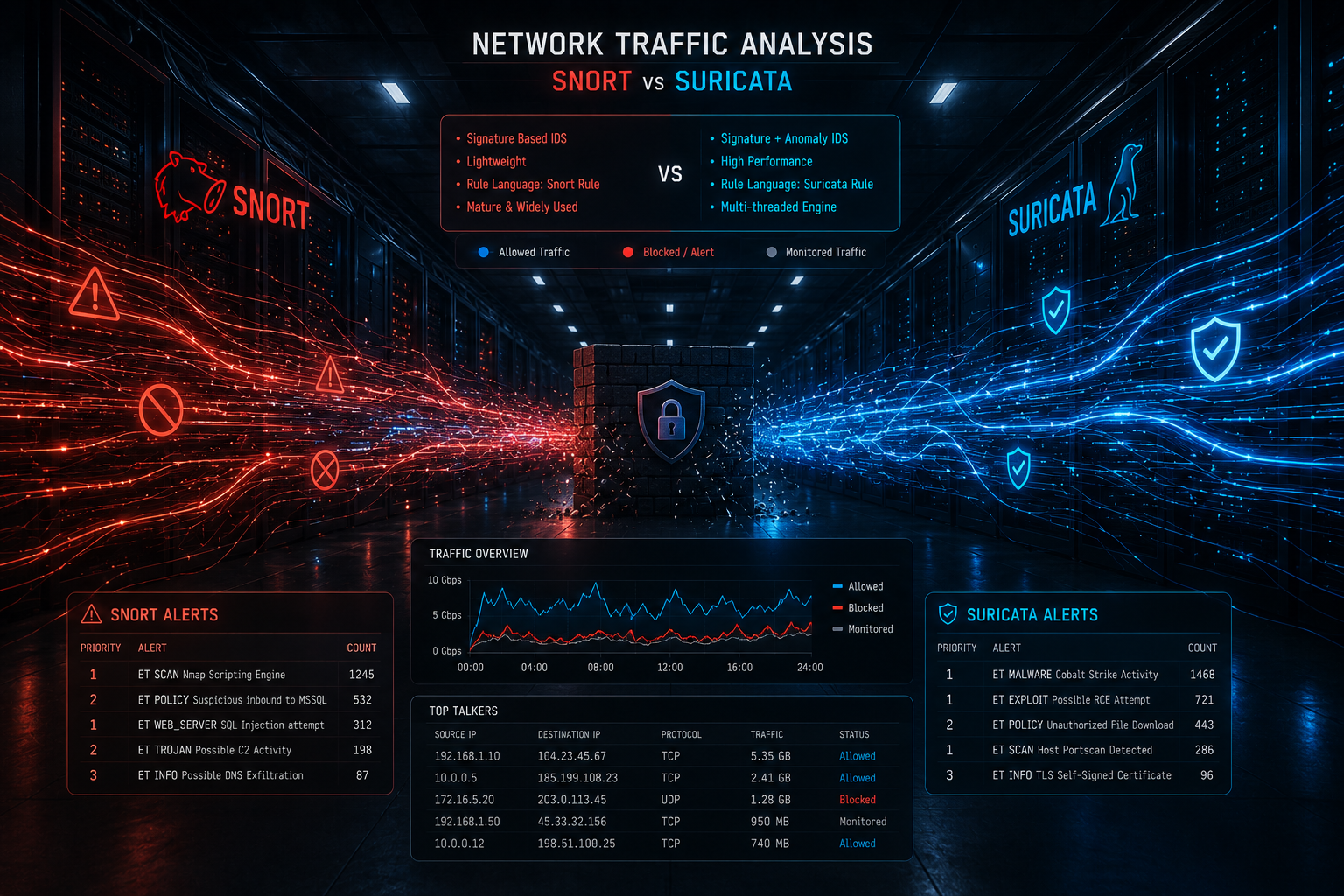
Snort vs Suricata: the other IDS debate.
Snort defined the rules format the whole industry still writes in. Suricata rebuilt the engine underneath it for modern, multi-core hardware. Here's what that actually changes.
Ask five practitioners "Snort or Suricata?" and you'll get five different answers, most of them a decade out of date. Snort, first released by Martin Roesch in 1998 and later stewarded by Cisco's Talos team, wrote the signature format the entire industry still writes rules in — alert, msg, sid, flow, all of it. Suricata, built by the Open Information Security Foundation starting in 2009, took that lineage and rebuilt the engine underneath it for hardware Snort's original architecture never had to plan for: multi-core boxes moving tens of gigabits a second. Neither tool is obsolete. The real question is which architecture matches the network, and the team, in front of you.
Quick verdict
| Use case | Pick |
|---|---|
| Long-running, well-known signature format, huge community rule sets (Snort VRT/Talos) | Snort |
| High-throughput network, multi-core hardware you want fully utilized | Suricata |
| Want built-in multi-threading without extra tuning | Suricata |
| Need IPS (inline blocking) with the most mature, battle-tested engine | Either — both support inline mode today |
| Want native TLS/JA3 fingerprinting and richer protocol-level logging out of the box | Suricata |
How they actually differ under the hood
Snort's classic 2.x engine runs detection on a single thread per process. That was a reasonable design in the late '90s and stayed adequate for most enterprise links for years afterward, but it meant that scaling Snort up to saturate a 10G, 40G, or faster interface required bolting on extra capacity from the outside — running several Snort instances behind a load balancer, or manually spreading traffic across NIC queues and pinning an instance to each one. It works, but it's an operational workaround, not a native capability. Snort 3, the rewritten engine that reached general availability in 2021, is a genuine improvement here: it added real multi-threaded packet processing and can use multiple cores natively within a single running process. That closes a lot of the historical gap, and it's worth crediting rather than repeating the old "Snort is single-threaded" line as though nothing changed. It's also worth being honest that a large share of production Snort deployments are still running the 2.9.x branch, where the old constraint still applies in full.
What Snort has always had, and still has more of than anyone, is rules and rule-writers. The syntax it introduced is the lingua franca of network signature detection, and Cisco Talos maintains one of the largest and most actively curated commercial-grade rule feeds in the industry, built on decades of accumulated tuning and false-positive suppression.
Suricata was architected from day one to run multiple threads across every available CPU core in a single process, using packet acquisition methods like AF_PACKET, PF_RING, or NIC-level RSS/symmetric hashing to split incoming traffic across worker threads without an operator having to build external load-balancing to get there. That native design is the single biggest structural difference between the two engines.
The other structural difference is depth of protocol parsing. Suricata treats application-layer inspection — HTTP, TLS, DNS, SMB, and more — as a core part of the engine rather than an optional add-on, and it logs the extracted metadata directly into its eve.json output: TLS certificate subject and issuer, certificate validity windows, JA3/JA3S TLS fingerprints, and full file extraction over protocols like HTTP and SMB, all without needing a pile of extra custom rules to switch it on. That richer, structured logging is a genuine operational advantage for anyone feeding a SIEM downstream.
None of that makes existing Snort investment worthless if a team switches engines. Suricata was deliberately built to consume the same rule syntax as Snort and the Emerging Threats (ET) rule sets, layering only a modest set of Suricata-specific keywords on top. In practice, the vast majority of a tuned Snort or ET rule set loads and runs on Suricata largely as-is — years of signature tuning and suppression work aren't thrown away just because the engine underneath changed.
A minimal example makes the shared lineage concrete. This same rule line is valid syntax for both engines:
# a minimal rule, valid on both engines — flags a burst of SSH connection attempts from one source
alert tcp any any -> $HOME_NET 22 (msg:"SSH brute-force attempt"; flow:to_server,established; threshold:type threshold, track by_src, count 5, seconds 60; sid:1000001; rev:1;)

# action=alert  proto=tcp  src=any:any -> dst=$HOME_NET:22
# options: flow state, threshold (fire once per 5 hits in 60s from one src), sid/rev for tracking
Where each one falls short
Snort's biggest structural weakness has been squeezing full value out of high-core-count hardware on very high-throughput links. Even with Snort 3's multi-threaded packet processing, most published benchmarking and vendor guidance still points to Suricata pulling ahead on raw multi-gigabit throughput per box. And for the meaningful share of the install base still running the 2.9.x branch, the workaround remains the same as it's always been: run several Snort processes bound to different interfaces or NIC queues. More moving parts to manage, not a hard technical ceiling, but a real operational tax.
Suricata's default configuration is not lightweight. Full protocol parsing, TLS fingerprinting, and file extraction all cost CPU and memory even on a deployment that doesn't need the extra logging, and getting Suricata right on constrained hardware — an appliance, a branch-office box, a resource-capped VM — takes deliberate tuning: thread and CPU affinity, ring buffer sizing, and a conscious decision about which eve.json log types are actually worth keeping. Suricata's codebase also moves faster and covers more ground than Snort's, which is good for keeping pace with new protocols but means more frequent version-to-version changes to configuration syntax, keyword behavior, and default output formats that operators need to track across upgrades.
The verdict that survives production
Put those trade-offs next to modern hardware and the pull is fairly clear: most teams standing up a new deployment today, on multi-core boxes inspecting tens of gigabits, lean Suricata for its native threading and the protocol-level visibility — TLS/JA3, file extraction, rich DNS and HTTP metadata — that comes baked into the engine rather than bolted on afterward. Snort remains a completely valid, well-supported choice, particularly anywhere a team already has years of tuned rules, suppression lists, and institutional Snort expertise built up, where ripping out a working detection stack to chase an architecture win rarely pays for itself. This isn't a story about one tool being obsolete. It's a story about matching engine architecture, and the operational muscle memory already in the building, to the hardware actually doing the inspecting.